
Seed Selection Guide
Which Whitetail Hill seed should I plant?
Start with your plot, not the bag. The four things that decide which blend works are how much sun the spot gets, whether you can work the ground with equipment, how wet it stays, and how long you want the plot to last. The table below matches those conditions to the blend we built for them. Use the guide above for a personalized pick, or text us at 256-415-4085 with a photo of the spot.
Match your plot to a blend
| Your situation | Plant this | Why |
|---|---|---|
| Small plot (¼–2 acres) in or near timber, heavy deer pressure, want daylight buck movement | Kill Plot | Graze-tolerant brassicas, three clovers and chicory chosen to survive constant browsing in partial shade and keep regrowing into winter. |
| No tractor or tiller; a spot you reach on foot or by ATV | No Till No Problem | Every species in it tolerates shade and a shallow seeding depth, so it establishes when you rake the leaf litter back and broadcast before a rain. |
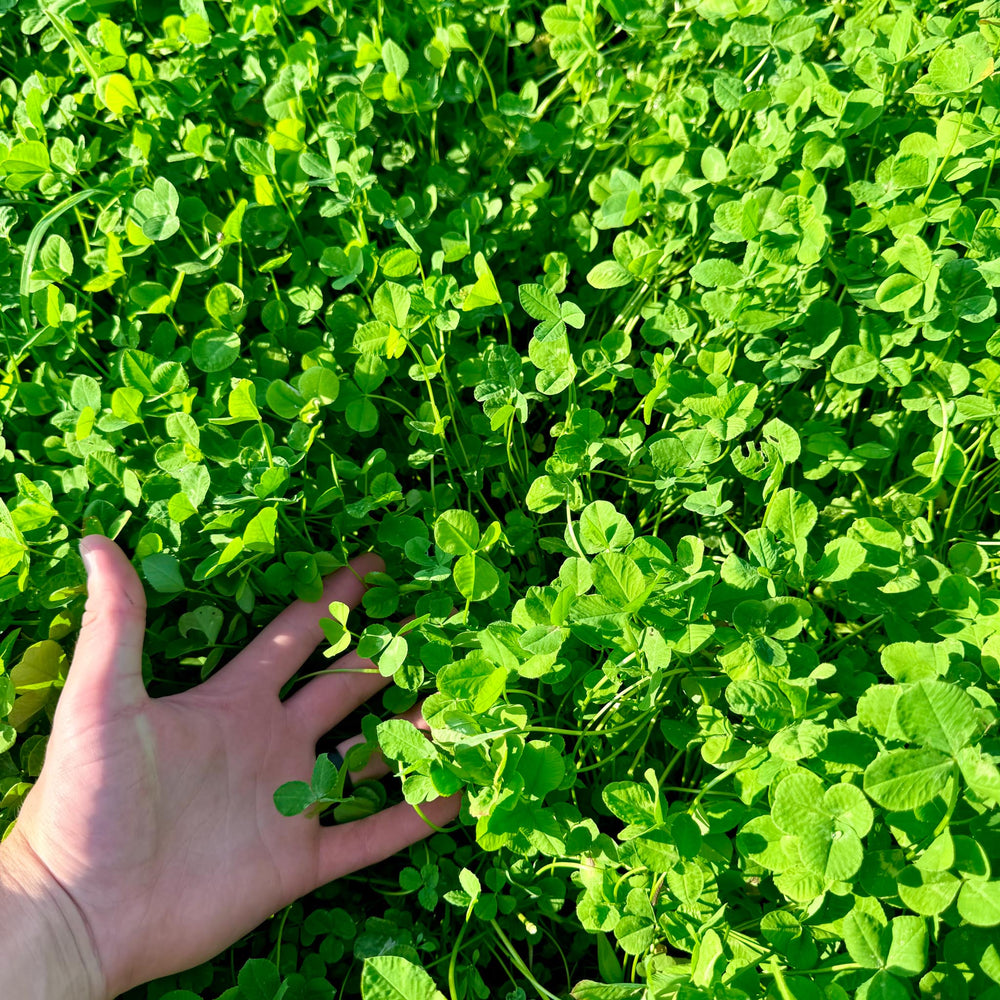
| Want a plot that lasts 3–5 years without replanting | Whitetail Hill Clover or Multi-Year Mix | Whitetail Hill Clover is five clovers rated to -15°F, handling wet or dry ground. Multi-Year Mix adds chicory and wants well-drained soil. Both take frost seeding. |
| Hunt deer in fall and turkeys in spring on the same ground | Bucks and Beards | Clovers and chicory for fall and winter, triticale as a nurse crop, then a spring flush of growth and grain heads that pull gobblers. |
| Low spot or wet corner that stays damp (not standing water) | Soggy Bottoms | Turnips and the most moisture-tolerant clovers available. Opens up ground most seed won't grow in. |
| One annual bag for the whole season, hunting in the South or Central states | Early Draw | Oats, winter peas, forage soybeans, radish and clover. Attractive from bow season through late season where winters are mild. |
| One annual bag for the whole season in the North, or a late-season plot in the South | Late Draw | Heavy on cold-hardy brassicas (rutabaga, rape, New Zealand types) with triticale, winter peas and clover. Built to outlast hard cold. |
| Late-season and winter hunting; deer in your area haven't taken to brassicas before | Late Season Brassicas | Five brassicas picked for the shortest learning curve, regrowth after grazing, and bulbs deer dig through late winter. |
| Summer nutrition, and keeping weeds out of fall plots | Summer Bulk | Forage soybeans, cowpeas, sorghum, buckwheat and jointvetch grow to 4 ft. Mow or disc it under in fall, or leave it standing for late-season grain. |
| Poor soil: log decks, old roads, eroded ground, more gravel than dirt | Dirt Doctor | Buckwheat for organic matter and weed suppression, tillage radish to break hardpan, clover to fix nitrogen. Plant a season or two, then plant anything. |
| Deer won't use the plot in daylight; big open field; need hidden stand access | Hideaway | Sorghums and millet of staggered heights grow a screen up to 12 ft. Split big fields, screen a corner, or plant a wall to your stand. |
| Dove field or quail cover | Dove & Quail Plot | Two millets and grain sorghum. No sunflowers, because deer mow young sunflowers before a field gets going. |
| Duck impoundment or pond edge you can flood | Waterfowl Blend | Millets, sorghum and buckwheat that hold grain on the stalk in wet conditions until duck season instead of rotting early. |
When to plant
Planting date matters more than seed choice. Fall plots need enough growth before the first hard frost but also need moisture, so plant ahead of a forecast rain rather than on a calendar date. These are the windows printed on our perennial blends (Whitetail Hill Clover, Multi-Year Mix, Bucks and Beards, Soggy Bottoms, No Till No Problem):
| Region | Spring | Fall |
|---|---|---|
| North | March–June | August–September |
| Central | March–May | August–October |
| South | — | September–early November |
Clover-based blends can also be frost seeded in late winter, 3–5 weeks before your last frost. Annual fall blends (Early Draw, Late Draw, Late Season Brassicas, Kill Plot) go in roughly 45–60 days before your first frost. Summer Bulk and Dirt Doctor go in after soil temperatures reach about 65°F. Every bag has its planting window printed on the label.
Before you buy
How much seed do I need?
Every bag is labeled by coverage: quarter-acre and third-acre jars for a single small plot, one-acre bags, and 2–4 acre buckets. Measure your plot in the Whitetail Hill app or pace it off; a 70 × 70 yard opening is about an acre.
Do I need a soil test?
Yes, if you've never tested that ground. Most plot failures trace back to pH below 5.5. Our soil test kit returns pH, buffer pH, N-P-K, calcium, magnesium, organic matter and CEC with lime and fertilizer recommendations. Every blend we sell wants a pH of 5.5–7.0.
Can I mix blends?
You can, but you usually don't need to; each blend is already a composite. The one combination we recommend on purpose is Early Draw in one plot and Late Draw in another, so deer traffic shifts from one to the other as the season goes on.
What's the difference between Kill Plot and No Till No Problem?
Both handle shade and small plots. Kill Plot is heavier on brassicas and chicory and built for graze tolerance and late growth; pick it when deer pressure is the problem. No Till No Problem is built for establishment with no ground prep; pick it when equipment access is the problem.
Is the seed tested?
Every lot is third-party tested for purity and germination before it ships. No filler species, no annual ryegrass.