Food Plot Strategy: What to Think About Before You Plant This Fall
Every year, guys plant food plots the same way: grab whatever seed looked good at the store, throw it wherever there's an open spot, and hope for the best. Some of those plots turn out fine. A lot of them don't.
A food plot that produces good daylight movement isn't complicated, but it usually comes down to a handful of decisions made before you ever get seed in the ground: the shape of the plot, what seed blend actually fits your ground and how you hunt, what equipment you have to work with, and what region you're planting in. None of it is complicated, but it's worth thinking through before your window opens this fall.
1. What Shape Should Your Food Plot Be?
Shape is one of the more overlooked variables in food plotting, and it changes depending on what job the plot is doing.
If you're building a destination plot, a bigger field meant to feed the herd, shape matters less. Round or square fields work fine because the goal is volume: hold a lot of deer, produce a lot of tonnage, and give hunters good visibility for gun season.
If you're building a kill plot, shape matters a lot more. Long, irregular plots with bends and points tend to hunt better than round ones because they play to how deer actually move: along edges, not through the middle of open ground.
A few shapes we come back to again and again:
The Hourglass. Two larger feeding areas connected by a pinch point in the middle. That pinch acts as a natural choke, and it's where your stand goes. Deer moving from one end to the other pass within easy range.

The Vee. Shaped like the letter V, this design pulls deer toward the bend to survey the rest of the plot before committing. A stand near the point puts you in the path of nearly everything that enters.

The Snake. A long, narrow plot with a gentle curve. Deer can't see straight from one end to the other, so curiosity walks them the length of the plot to check out what's around the bend. Hunt the middle.

The Turkey Foot. Several narrow "toes" meeting at a central hub, working on the same principle as the Vee. Deer travel to the hub to check each leg, so that's where you hang the stand.

All four rely on the same two things: keeping deer close to cover, and limiting visibility so no single vantage point shows a deer the whole plot at once. There are plenty of other shapes built on the same logic. Worth trying one this fall if you haven't.
The general rule: the bigger and more feeding-focused the plot, the less shape matters. The smaller and more hunting-focused the plot, the more it matters.
2. What Seed Blend Is Best for You?
This is where a lot of food plots are won or lost, months before anyone climbs into a stand. It's also where a lot of guys try to save a few dollars and end up paying for it all season. Cheap seed from the co-op looks like a bargain at checkout, but low-quality fillers, poor germination, and species deer barely tolerate cost you a lot more than the difference in price once you're staring at a thin, untouched plot in November.
Some species, clovers, peas, and the right brassicas (radishes, sugar beets, rutabagas, forage rapes), are preference food. Others, like kale, and rye grass, are desperation food and cheap fillers companies use to bulk up a bag, species deer only eat when nothing better is around. That's exactly why you won't find them in any Whitetail Hill blend. Every Whitetail Hill blend is formulated to be attractive and nutritious to deer, often built around hard-to-get ingredients you won't find in a bargain bag off the shelf.
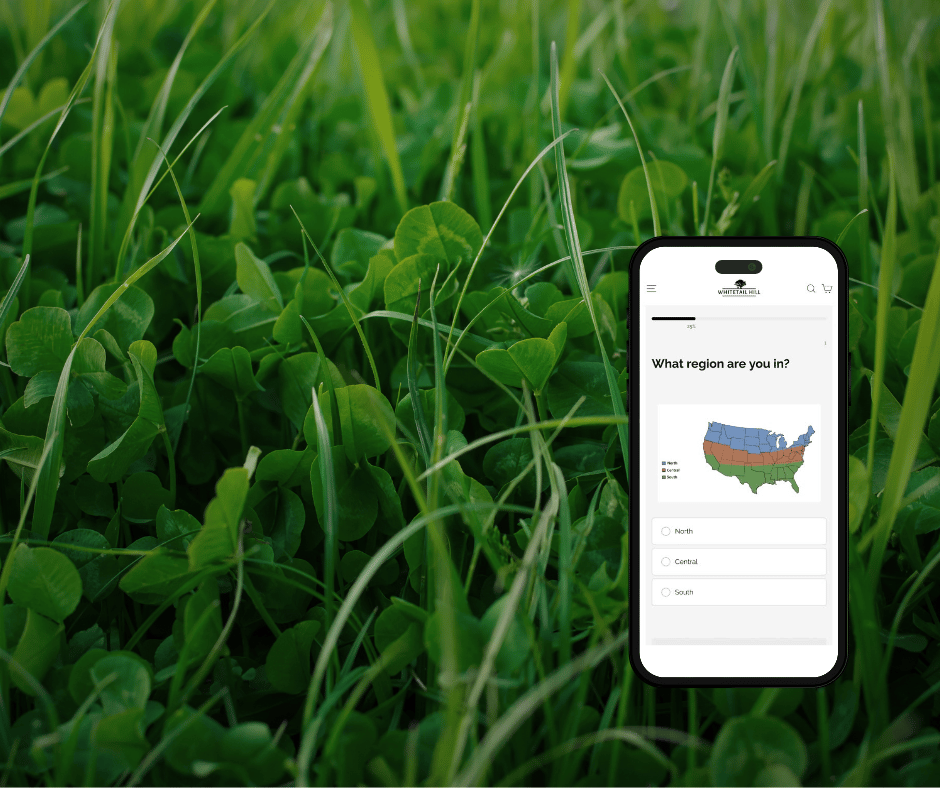
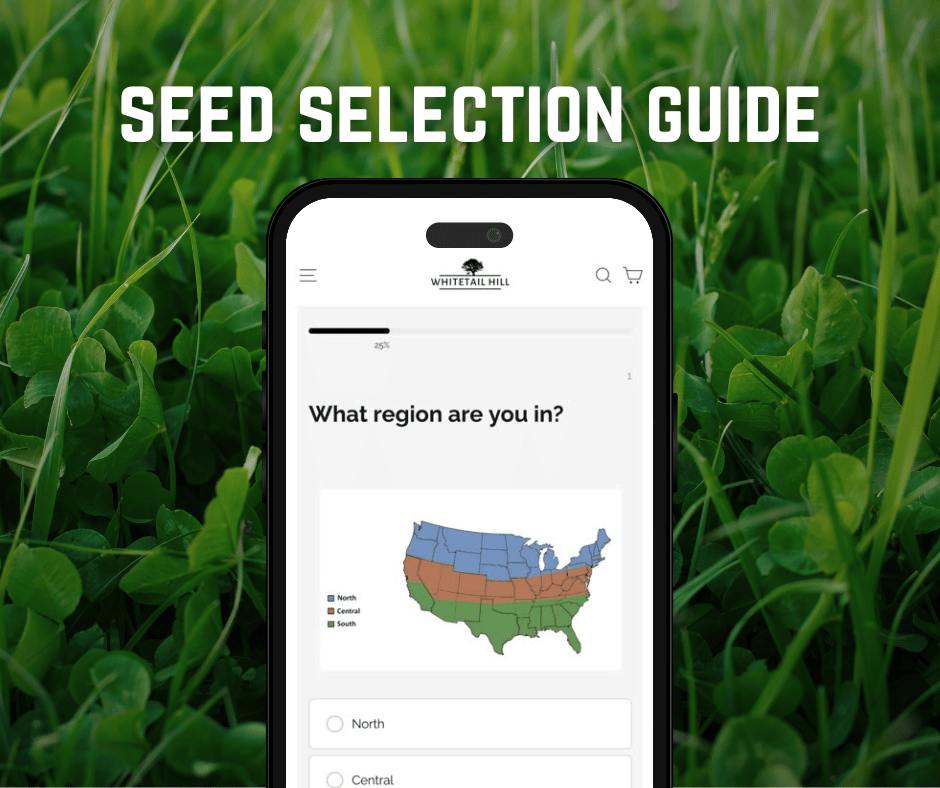
With options for early season, late season, no-till ground, wet ground, perennial plots, and more, there's a good chance we've already built something for your exact situation. Our Seed Selection Guide matches you to the right blend in about a minute, sorting by when you hunt, what your ground looks like, and whether you want an annual planting or a perennial plot that comes back on its own.
3. What Equipment Do You Have Access To?
Not having a tractor isn't a reason to skip planting. It's a reason to plant differently.
If you've got a tractor, disc, and time, conventional tillage still works great, especially on bigger destination plots where turning soil and controlling weeds at scale matters.
If you don't, or if the plot you want is in a spot no tractor will ever reach, like a logging road landing, that's exactly the scenario No Till No Problem was built for. It's a broadcast blend of cereal grains, clover, radish, and chicory, chosen specifically because every species in the bag establishes with nothing more than surface contact and rain. Spray the existing vegetation, give it 10 to 14 days to die back, broadcast seed just ahead of a soaking rain, then mow the dead thatch down on top of it. The thatch becomes your seed cover and moisture blanket, and the rain does the rest. All you need is a backpack sprayer, a hand-crank spreader, and a mower or weed eater.
The one thing that changes with your equipment is seed selection. Broadcast, no-till plots need small seed that germinates on surface contact. Anything that needs to be buried an inch deep will fail no matter how well you execute the method.
4. What Region Are You In?
Your region decides when your planting window opens and getting that wrong causes more disappointing plots than bad seed or bad soil ever will.
Brassicas need the longest runway before frost, so they go in the ground first. Cereal grains and clover follow, planted later so the grains don't bolt and get stemmy before season. Rough regional windows look like this:
- North: Brassicas in July–August; grain and clover mixes August–September
- Central: Brassicas in August–September; grain and clover mixes August–October
- South: Brassicas in September–October; grain and clover mixes into early November
The date on the calendar is only half the equation. The bigger factor is rain. Seed sitting in dry dirt doesn't grow. Once your regional window opens, stop watching the calendar and start watching the radar. A plot planted a few days ahead of a soaking rain will beat a plot planted "on schedule" into dust every time. The real advantage goes to the guys who already have seed and a prepped seedbed on hand before their window opens, so they can plant the moment a good rain shows up instead of scrambling for supplies while it's raining on someone else's plot.
Putting It Together
None of this happens in isolation. Your region sets your calendar, your equipment decides how you prep the ground, and your seed blend depends on both. Shape mostly matters if the plot's job is hunting rather than feeding. Worth working through before you plant, so you know roughly what to expect out of the plot this fall.
Frequently Asked Questions
What's the ideal shape for a food plot?
It depends on the plot's job. Destination plots meant to feed the herd can be round or square. Kill plots meant for hunting tend to work better long and irregular, with bends and points that create edge, funnel deer past a stand, and let bucks use the plot in daylight without feeling exposed.
How much of my property should be in food plots?
A common guideline is 5 to 10% of your total acreage, split between kill plots and destination plots based on your property layout and herd needs.
What's the difference between a kill plot and a destination plot?
Kill plots are small (a quarter to half acre), tucked near bedding, and designed to create close-range shot opportunities. Destination plots are larger (2 to 5 acres or more), placed in open ground like old fields or pastures, and designed to feed and hold more of the herd.
Do I need a tractor to plant a good food plot?
No. A backpack sprayer, a hand-crank spreader, and a mower will plant a productive plot using a no-till, broadcast method. Blends like No Till No Problem are built specifically around species that establish from a surface broadcast, no tilling required.
When should I plant my food plot?
It depends on your region and what you're planting. Brassicas need the most runway and go in first: July–August in the North, August–September in Central states, and September–October in the South. Grain and clover mixes follow a few weeks later. Regardless of region, plant just ahead of a soaking rain rather than on a fixed calendar date.
Should I plant one blend or several?
If you only have one plot, match the blend to when you hunt most. If you have more than one plot, plant different blends for different jobs, so your property has a food source peaking every week of the season. Run your setup through the Seed Selection Guide and let it do the matching.
What should I do before my planting window opens?
Pull a soil test, control existing weeds, prep your seedbed, and get seed and lime on hand. That way, when your window opens and a good rain is in the forecast, you can plant immediately instead of scrambling for supplies.