
Lime and Fertilizer for Food Plots: What Actually Grows a Better Plot
Lime and Fertilizer for Food Plots: What Actually Grows a Better Plot

It's a familiar pattern: good seed, decent rain, a couple bags of whatever fertilizer was on the shelf at the co-op, and the plot still comes up thin with deer barely touching it. The instinct is usually to blame the seed or the weather. More often than not, the real problem is happening six inches underground, not in the bag. Lime and fertilizer only work if you understand what the soil is actually doing, and the only way to know that is to test it.
Why Soil pH Is the First Problem to Solve
Most soil across the whitetail's range runs acidic, and that creates a problem no amount of fertilizer can fix by itself.
Soil pH runs on a logarithmic scale, so small differences are actually massive ones. A plot sitting at 5.5 pH isn't a little more acidic than one at 6.5, it's ten times more acidic. And at that pH, over half of the fertilizer you spread never even makes it into the plant. It's chemically locked in the dirt, completely unavailable to the roots. You paid for it, you spread it, and the plant never saw a dime's worth of it.
Most food plot species, clover, brassicas, cereal grains, soybeans, do best somewhere between 6.0 and 7.0. Drop below that and plants start struggling to pull calcium, magnesium, and potassium out of the ground, no matter what you've applied. That's where the old rule of thumb comes from: if you can only afford lime or fertilizer, buy the lime. Fixing pH is what makes everything else actually work.
Lime alone will often grow a better plot than fertilizer alone, simply because it unlocks nutrients that were already sitting in the soil doing nothing. Combine the two, correct pH first and feed the plot second, and you get noticeably more forage and better quality than either input can produce by itself. Lime isn't a nice-to-have. It's the thing that makes your fertilizer worth buying in the first place.
The Only Way to Know What Your Plot Needs: Test It
You can't eyeball pH, and you can't guess your way into the right fertilizer blend. A soil test is the only way to know exactly what's going on before you spend a dime, and it usually costs less than a bag of seed.
A good test comes back with your current pH, your buffer pH (used to calculate your exact lime rate), and your phosphorus, potassium, calcium, and magnesium levels. From there you get a straight answer: this many tons of lime per acre, this many pounds of N-P-K. No more grabbing a bag of 13-13-13 off the shelf and hoping it happens to match what your dirt actually needs.
That's why it's worth pulling a sample before planting anything. The Soil Test Kit covers exactly that: collect a sample, mail it in, and get a lab report back with clear recommendations for that specific plot. And if you've never pulled a soil sample before, Why You Need a Soil Test walks through exactly how to do it.
A couple things that make a real difference in your results: pull from a few different spots in the field rather than one scoop by the gate, take them from the top 6 inches of soil, and mix them together into one sample before you send it in. One sample from one corner of the plot won't tell you much about the rest of the field. Plan to retest every year, since pH and nutrient levels shift as you plant, fertilize, and let rain wash things through the soil profile.
Ag Lime, Pelletized Lime, or Liquid Lime?
Once your test comes back with a lime recommendation, you've got some decisions to make on what to actually buy.
Bulk ag lime is ground limestone, and it's the most cost-effective option for anything an acre or bigger. It's got both fine and coarse particles, the fine stuff reacts fast to start moving pH, and the coarse stuff breaks down slowly over the following years to hold that pH in place. The catch is you typically need a spreader truck, which isn't always an option on a plot buried two ridges back.
Pelletized lime is ag lime ground fine and pressed into pellets so it'll run through the same broadcast spreader you use for seed. That makes it a lot more practical for small or hard-to-reach plots. It works faster than bulk lime but costs a good bit more per acre and doesn't last as long, so expect to reapply, and retest, sooner.
Liquid lime gets sprayed straight onto the soil surface. It's the most expensive option by far and really only makes sense for plots where nothing else will work. You also have to be careful with what you buy in this category. Many “liquid lime” products are nothing more than calcium chloride that does nothing to correct your pH. Snake oil in a jug. If the product you’re eyeing doesn't say what’s actually in it there’s a good chance the company selling it is trying to hide it and that probably means its not going to adjust your pH.
Real liquid limes that work should include one of these:
Calcium carbonate — CaCO₃: the standard and most common liming material.
Dolomitic limestone — CaMg(CO₃)₂: raises pH while supplying calcium and magnesium.
Less commonly, calcium hydroxide—Ca(OH)₂ or calcium oxide—CaO are real liming agents, but they are caustic and require careful handling.
Fake liquid limes that will not adjust your pH will have these ingredients:
Calcium chloride — CaCl₂
Calcium nitrate
Calcium thiosulfate
Calcium acetate
Chelated calcium
Calcium sulfate or gypsum — CaSO₄
Products listing only “soluble calcium,” “available calcium” or an elemental calcium percentage.
Doesn’t say what’s in it? Don’t buy it until you know. There are many companies right now selling calcium chloride or its equivalents as fake lime products. Don’t fall for it.
How Much Lime Do You Actually Need?
Your test gives you a recommendation of exactly what to apply, go by tat and you’re golden. Ag lime and pelletized work at roughly the same rate so you can use the soil test recommendation for either one.
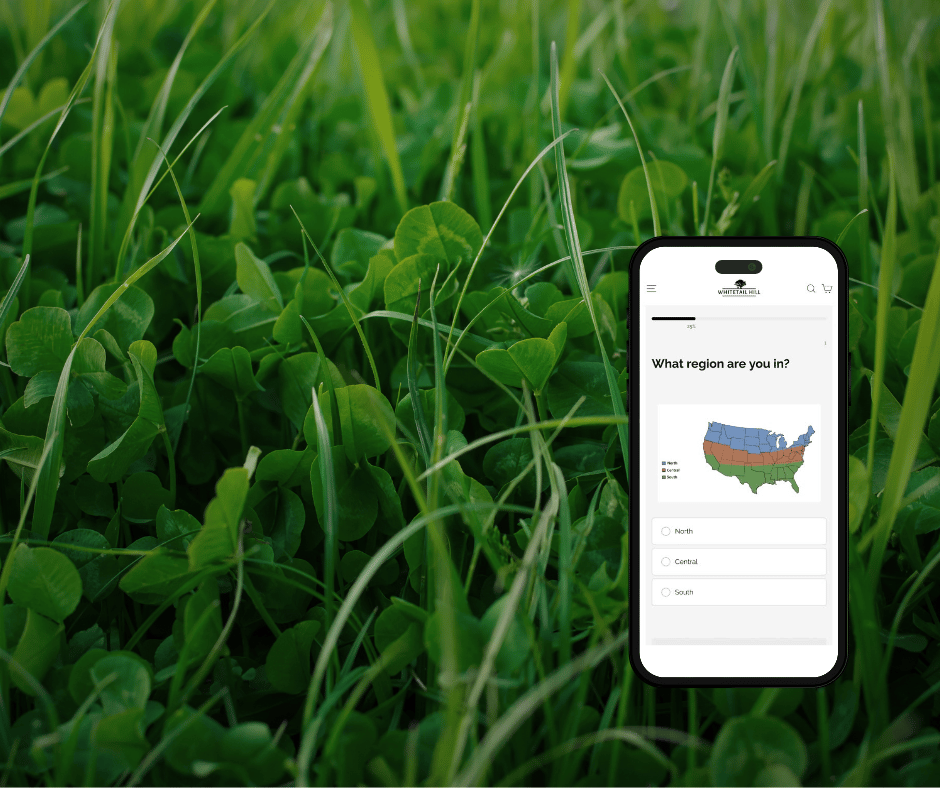
The easiest way to turn your soil test into plain english terms for your plot? The Whitetail Hill app. We have a soil test calculator there that takes your soil test report and turns it into exact recommendations for each plot adjusted for size and put in plain english. No more math.
Lime works slow, it can take weeks to months to fully shift your pH, and unlike fertilizer, it doesn't move through the soil on its own. It needs to be worked into the ground for best results, not just left sitting on top. That's why it pays to get lime down well ahead of planting, ideally a few months before, instead of trying to fix your pH and plant seed the same week. If you have to do that, you can and guys still get good plots that way but just know its always best to apply in advance.
Sandy soil takes lime fast but loses the correction sooner. Clay soil takes longer to respond but holds it for longer. And if your test calls for four tons of lime per acre or more, plan on retesting the following year to make sure the pH actually landed where it needed to.
Getting the Fertilizer Side Right
Once pH is corrected, fertilizer can finally do its job. This is where the numbers on the bag start to matter. The three numbers, N-P-K, are percentages based on 100 pounds, not 50. That means a 50-pound bag of 13-13-13 only has about 6.5 pounds each of actual nitrogen, phosphorus, and potassium. If your test calls for 40 pounds per acre of each, you're looking at roughly 300 pounds of that bag per acre, not one sack.
Sound complicated? It is. There are a lot of conversions to do to get the math right and then when you do it’s time to try and turn that into lbs of actual product. It never works out exactly even so you’re going to have to find the closest mix of fertilizer to get you where you need to be. The easiest and fastest way to skip the math and the headache is again the Whitetail Hill app. The soil test calculator there takes your soil test report and turns it into exact fertilizer and lime recommendations for each plot adjusted for size and put in plain english. It even turns your fertilizer recommendations into commonly available products. For example, your soil test report might say you need 10lbs of Phosphorus, 23lbs of Nitrogen, and 12lbs of Potassium per acre. You have a ¾ acre plot and your local farm store only sells a few types of fertilizer. The soil test calculator is going to take that info and give you a plain english plan, something like “based on your soil test you need to apply 47lbs of 13-13-13 and 10lbs of 46-0-0 on that plot” (fictional numbers for example's sake). That plan is already adjusted for the size of your plot and put into common fertilizer products that stores actually sell. It doesn't get easier than that.
Choose Your Crop
Different crops need different ratios. Legumes like clover, soybeans, and winter peas fix their own nitrogen through bacteria in their root nodules, so they need a lot less nitrogen than a grain crop, but that whole process only works well when soil pH is in range, which loops right back to lime coming first. Grain-heavy plots like corn, wheat, oats, and brassicas are nitrogen hogs and often do better with a mid-season top-dress of nitrogen to carry them through the growing season. If you use a Whitetail Hill Soil Test you’re going to be able to select exactly which crop you’re planting and get the right recommendations for that crop because it varies widely. Late Season Brassicas needs way more nitrogen than something like Whitetail Hill Clover. Most other soil test will give you generic results for row crops like corn and soybeans that are drastically different from the species that are going in your food plots. Use a soil test that is made for food plots and gives recommendations for the species you actually plant.
The Mistakes That Waste the Most Money
The single most expensive mistake in food plot management is spreading fertilizer year after year without ever checking pH. If your soil is acidic, most of that fertilizer is wasted no matter how much you buy. Other common misses: spreading lime on top of the ground and never working it in, grabbing whatever lime is cheapest without checking the type, and planting nitrogen-hungry crops like corn or brassicas with no plan for a follow-up nitrogen application.
The fix for basically all of it is the same: test before you spend.
The Bottom Line
Lime and fertilizer aren't competing line items. They work together, and one doesn't do much without the other. Fix your pH first, feed the plot based on what the soil actually needs, and you'll grow more forage per dollar than the guys spreading fertilizer blind every year.
Before you buy another bag of anything, pull a sample. Grab a Soil Test Kit, find out exactly where your pH and nutrients stand, and put your money where it'll actually grow something.
Frequently Asked Questions
Q: How do I know if my food plot needs lime?
A: Test it. Visual cues like weeds or thin growth can hint at a pH problem, but a soil test gives you an exact reading and a specific lime recommendation in tons per acre. No guessing required.
Q: What's the ideal soil pH for a food plot?
A: Most food plot species do best between 6.0 and 7.0. Below 6.0, a big chunk of any fertilizer you apply becomes unavailable to the plant.
Q: Should I put down lime or fertilizer first?
A: Lime first, and well ahead of planting if you can. It takes weeks to months to shift pH, and until that happens, a lot of your fertilizer is going to waste.
Q: Is pelletized lime actually better than ag lime?
A: More convenient, not more powerful. It spreads easily with regular equipment and reacts a bit faster, but it costs more and doesn't last as long. Bulk ag lime is the better value for anything an acre or bigger if you can get a spreader truck to it.
Q: How often should I soil test my food plots?
A: Test when you first establish a plot, then every year or two after that. If a test calls for lots of lime per acre, retest the following year to confirm it worked.
Q: Can you put down too much lime?
A: Yes. Overliming can push pH too high and lock up micronutrients like zinc and manganese. Stick to what the soil test says instead of applying extra "to be safe."
Q: Do clover and soybeans still need fertilizer if they fix their own nitrogen?
A: Yes, just less of it. They still need phosphorus, potassium, calcium, and the right pH for the nitrogen-fixing bacteria in their roots to actually function.